
For people who read papers
Keep track of every paper you read.
Papperoni reads your PDFs, files them in lists, matches their references and draws the citations between them. It's AI native: your library works in Claude Code, and an assistant is built in.
Papperoni is invite-only for now. See a reading list while you wait.
AI native
Your library, in Claude Code
Papperoni is made to be used by AI as much as by you. Connect Claude Code with one command and it can search your papers, read your PDFs, follow citations and update your lists and reading, as you, from the terminal you already work in. claude.ai, Claude Desktop, ChatGPT, Codex and Cursor connect the same way.
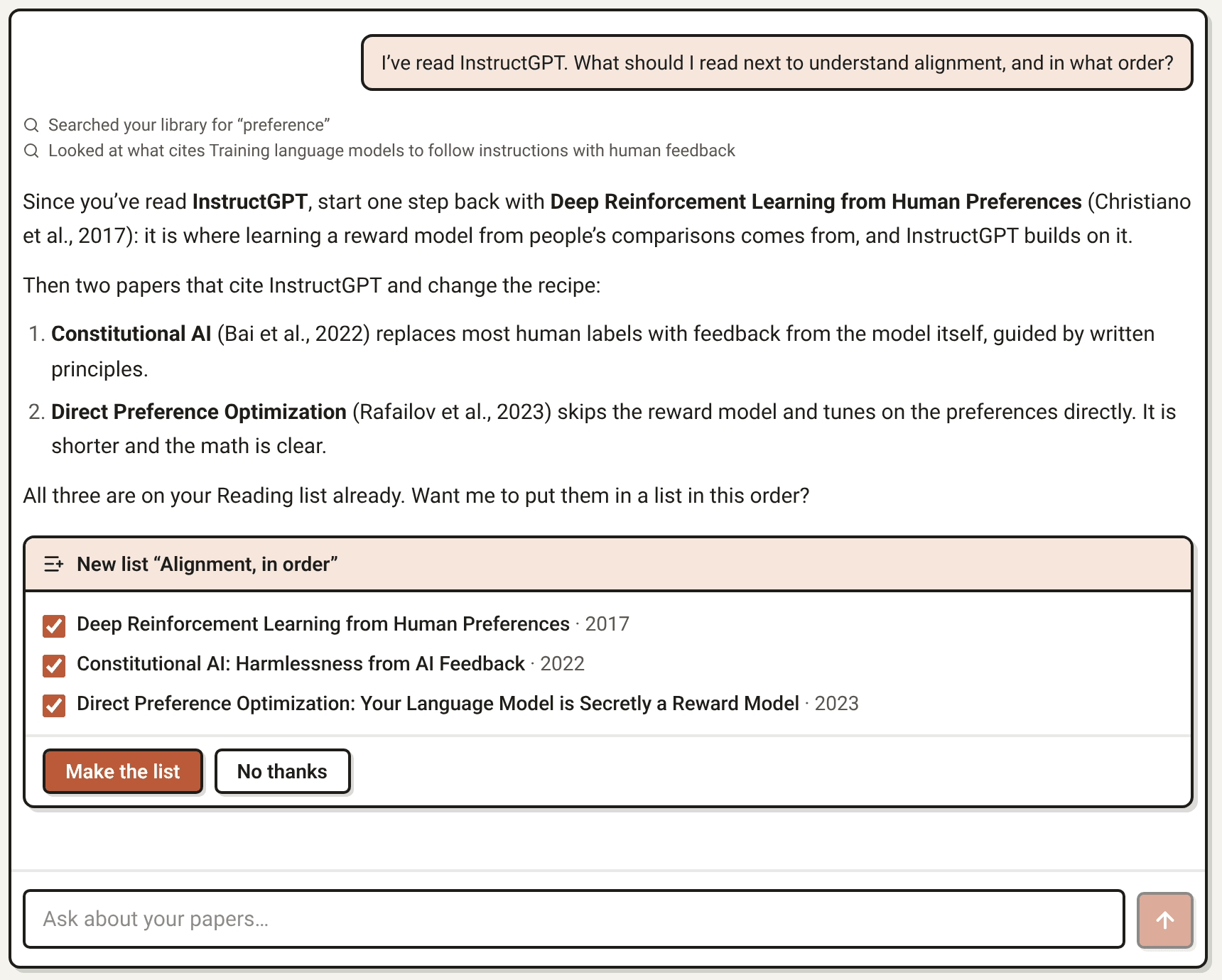
And there's an assistant built in, on every page. It knows your lists and what you've read, suggests what to read next and in what order, finds papers on arXiv, and proposes changes that happen only when you click.
- Claude Code in one command
- Reads and updates your lists
- Assistant built in
$ claude mcp add --scope user --transport http papperoni https://papperoni.com.br/api/mcp --header "Authorization: Bearer pp_…"
Added HTTP MCP server papperoni to user config
$ claude
> What have I read on learning from human feedback, and what should I read next?
⏺ papperoni · search_papers (query: "human feedback", read: true)
⏺ papperoni · related_by_citations (papers: 2)
⏺ You've read Deep RL from Human Preferences (2017) and InstructGPT (2022). Next: Direct Preference Optimization (2023). It cites both and is already on your Reading list.
> Tag it rlhf and add it to my Alignment list.
⏺ papperoni · tag_paper (add: ["rlhf"])
⏺ papperoni · add_to_list (list: "Alignment")
⏺ Done: tagged rlhf and added to Alignment.
Add
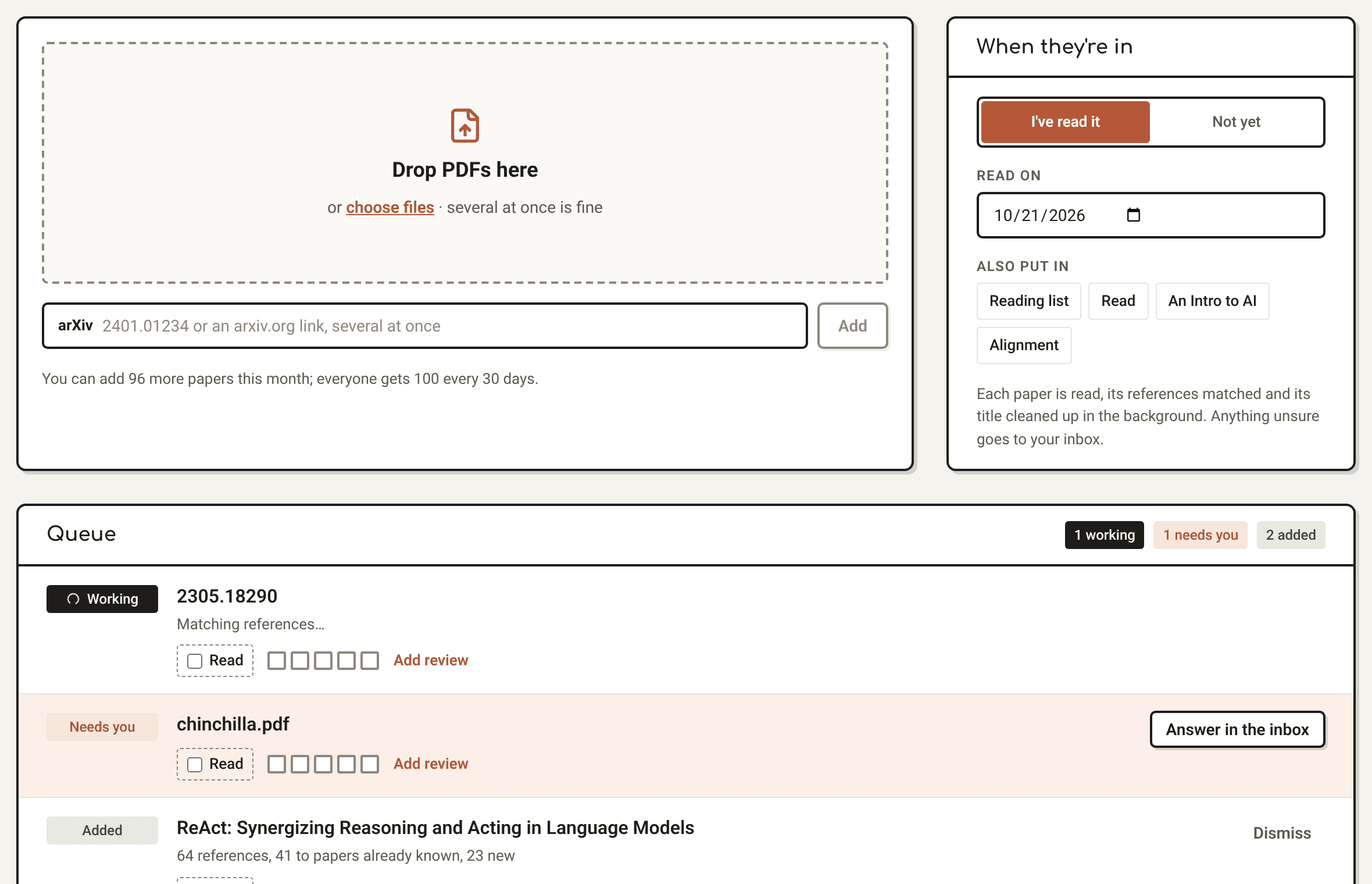
Drop in a PDF, Papperoni reads it
Add papers as PDFs, arXiv links or files from Google Drive, or let it watch a Drive folder. It reads the title, authors, summary and every reference from the PDF itself, scans included, and matches each reference to the paper it cites. When it isn't sure, it asks you in the inbox instead of guessing.
- PDF, arXiv or Drive
- References matched
- Asks when unsure
Lists
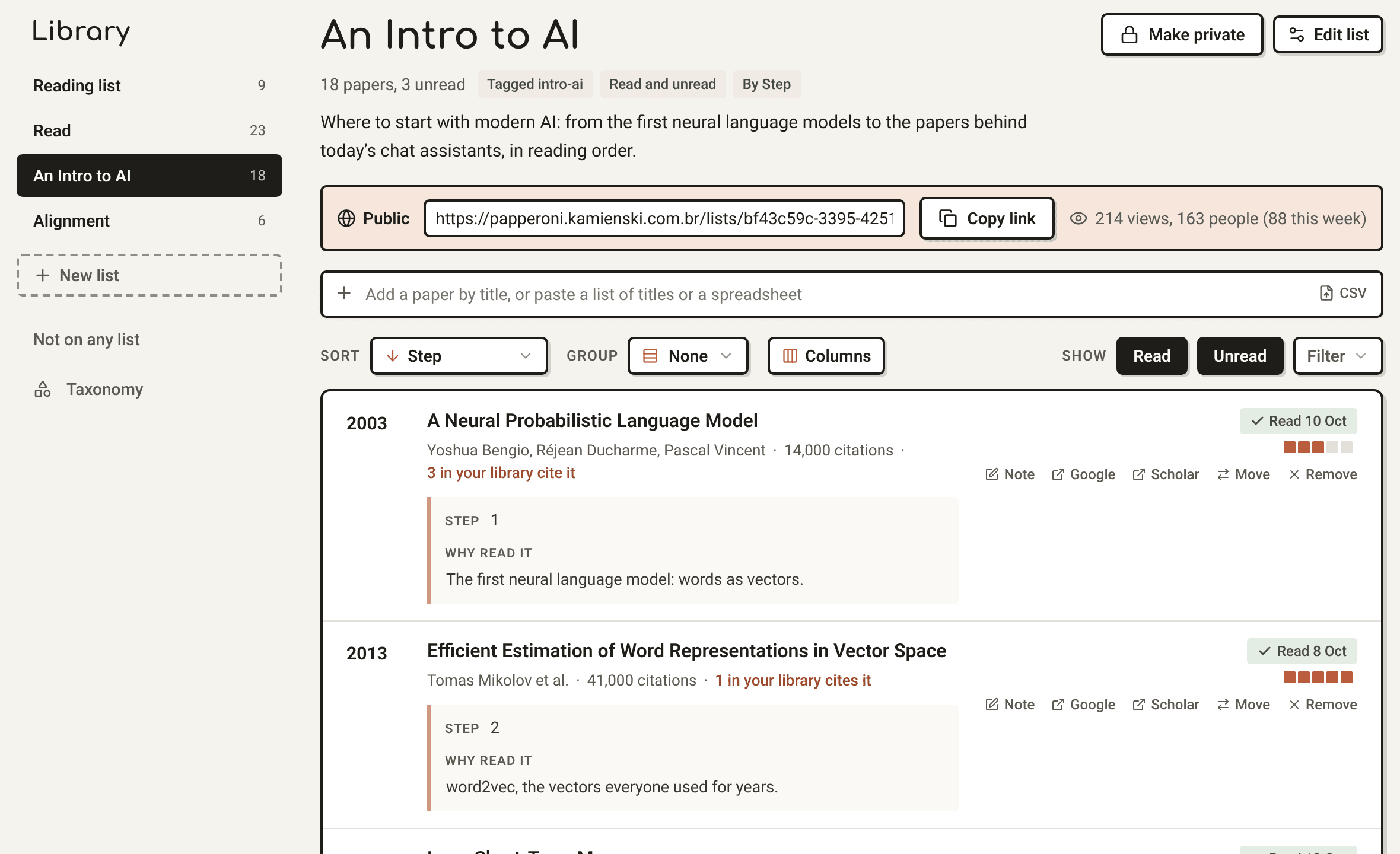
Lists that work like spreadsheets
Start with a Reading list and a Read list, then make as many as you like. Give a list columns of its own (why to read it, who recommended it, a step), paste a spreadsheet into it, sort and group it by any column, and share it with a public link.
- Your own columns
- Paste a spreadsheet
- Share by link
Graph
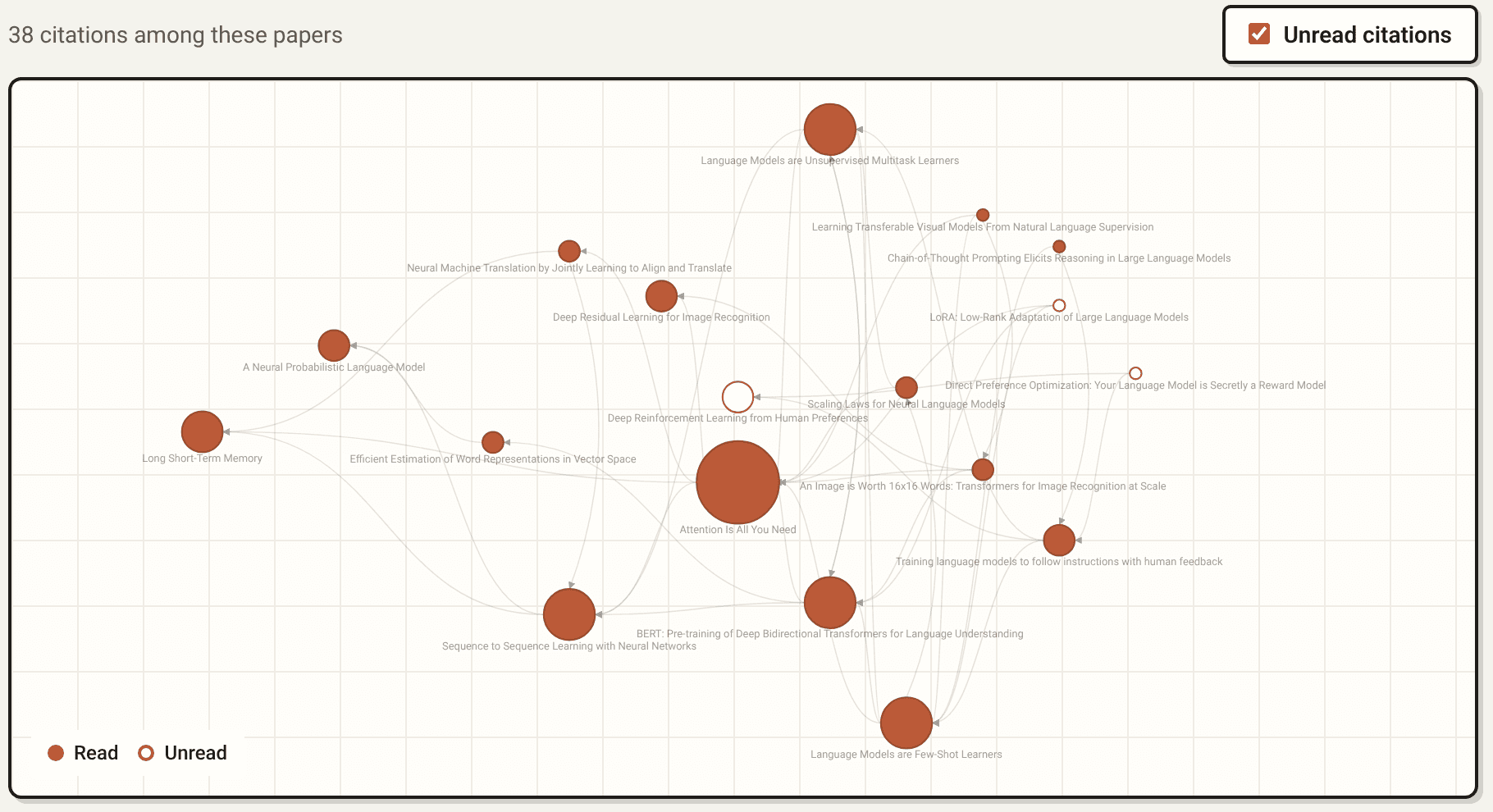
See how your papers cite each other
Because every reference is matched, your library becomes a citation graph. See what builds on what in a list or across everything you've read, and which unread papers your reading keeps pointing to.
- Per list or for everything
- Read and unread
- Find what to read next
Papers
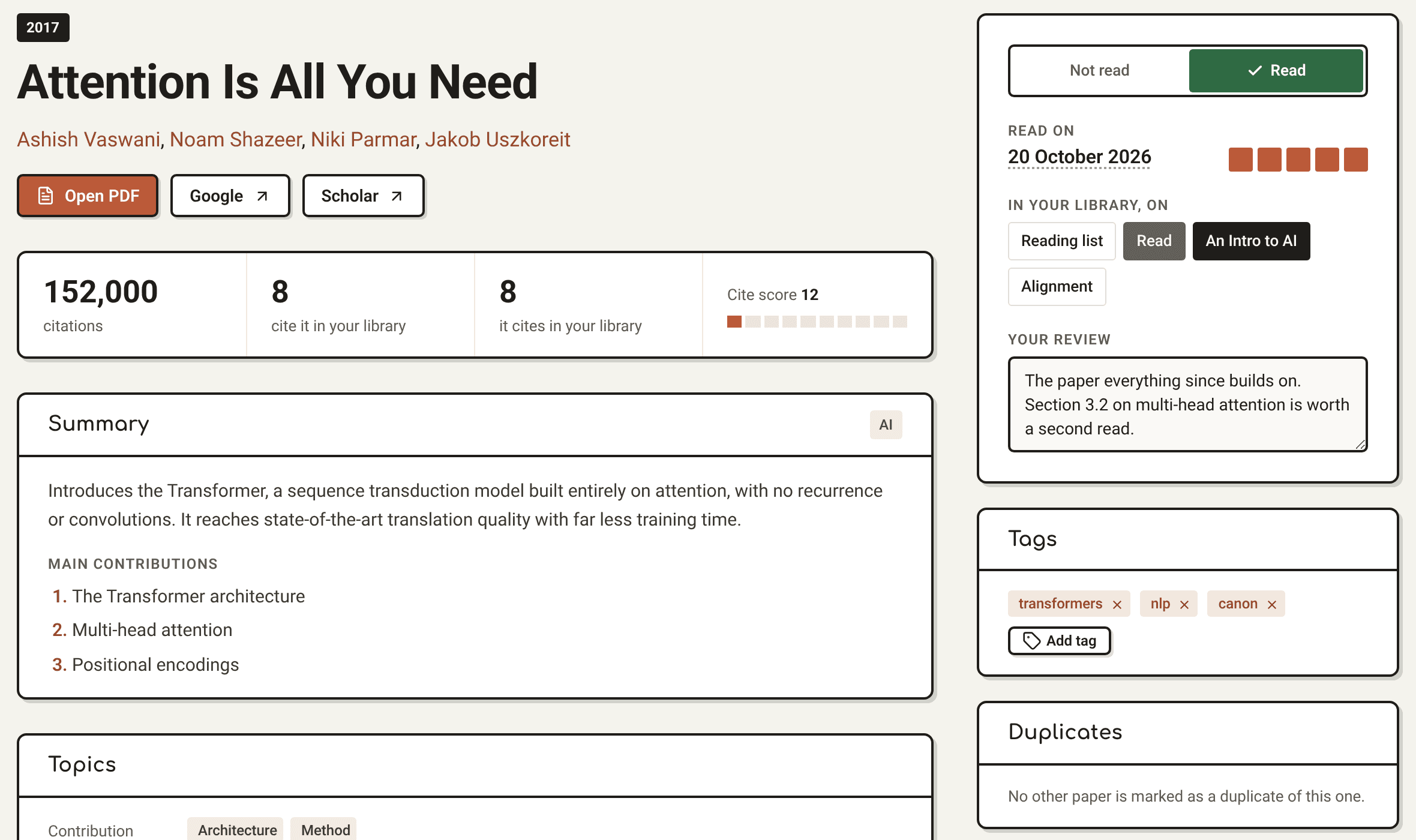
Every paper summarized and tagged
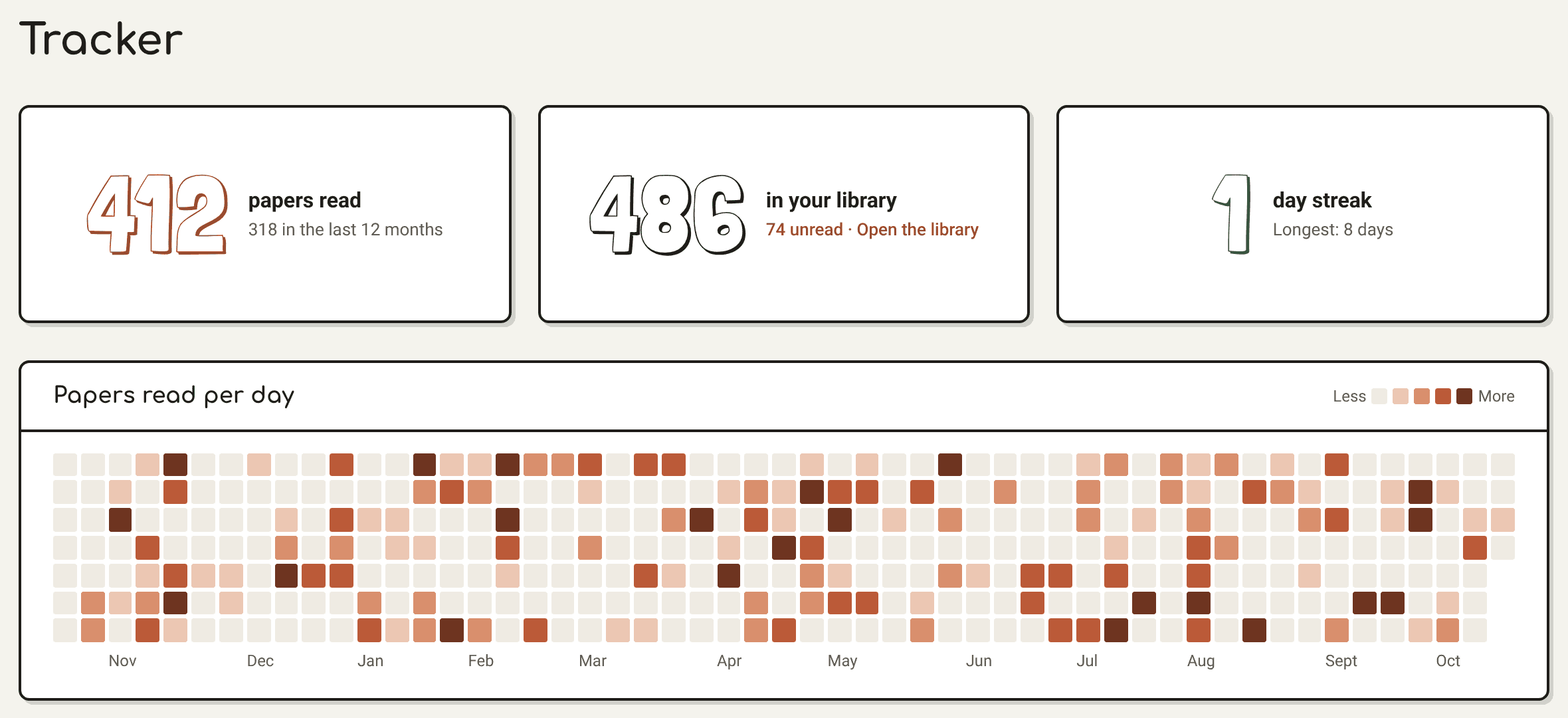
Each paper gets a short summary, its main contributions and topics from a shared taxonomy. Keep your read date, rating and review next to it, and see which of your papers it cites and which cite it.
- Summary and contributions
- Topics
- Your rating and review
A list to start with
Lists are made to be shared
Anyone can open a public list, no account needed.
An Intro to AI
A list by Arthur Kamienski · 50 papers, 1950 to 2025
Fifty papers that take you from Turing’s question to today’s reasoning models, in an order meant for a first read. Start with a few short essays, see how neural networks learn, follow language from word vectors to Transformers and large language models, then branch out to images, science and the engineering that makes it all run. Each paper has a theme and a line on why it’s worth your time.
- 1Computing Machinery and Intelligence1950
- 2Deep learning2015
- 3Is it Enough to Get the Behaviour Right?2009
- 4The Perceptron: A Probabilistic Model for Information Storage and Organization in the Brain1958
- 5Learning representations by back-propagating errors1986
Request access
Papperoni is invite-only for now. Leave the Google account you'd sign in with, and you'll be able to sign in once you're invited.
Already invited? Sign in with Google